Temple of Heaven Deep Tour: Decoding the “Mandate of Heaven” in Chinese Imperial Power
2026-11-02Introduction: The Stone Ark
Beijing has no shortage of grandeur. The Great Wall, the Forbidden City, the Temple of Heaven — they are enormous, photographed countless times, and sit near the top of every traveler’s checklist. But in the northwest corner of the city, next to the Beijing Zoo, there is a place so quiet you might walk right past it: a white marble terrace covered in carvings, with five small pagodas rising from its top.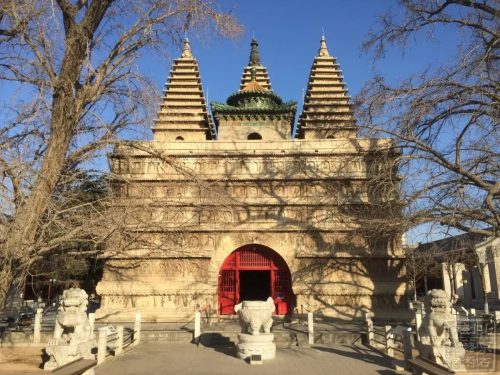
This was once a Ming-dynasty imperial temple called Zhenjue Temple. A great fire at the end of the Qing dynasty, followed by the demolition and sale of its halls during the Republican era, left only one structure standing by 1927 — the Diamond Throne Pagoda, standing alone amid the rubble.
Yet it was precisely this fate — being stripped down to a single tower — that saved it from every wave of urban redevelopment that followed. Decades later, it became a sanctuary for scattered stone carvings from across Beijing. Today, more than 2,600 stone artifacts from every corner of the city have gathered here: stones from vanished temples, stones from leveled cemeteries, stones dug up from beneath construction sites.
The Chinese carve onto stone whatever they most wish to preserve forever — imperial decrees, contracts, acts of faith, records of honor, expressions of grief. So this small, quiet museum is, in effect, a draft of Chinese civilization carved in stone — incomplete, perhaps, but remarkably honest.
──────────────────────────────────────────────────
The 3-Hour In-Depth Route: Reading China Carved in Stone
Stop 1: The Diamond Throne Pagoda — A Foreign Tower, Built with Chinese Hands
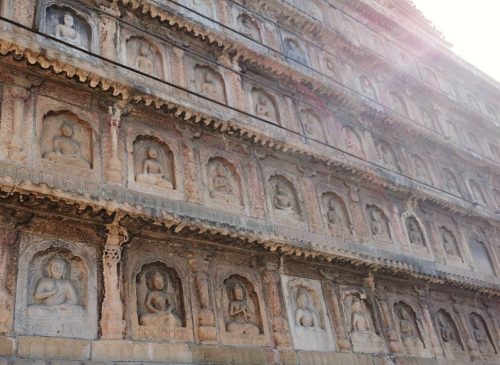
Built in 1473, during the Chenghua reign of the Ming dynasty, this is the oldest surviving Diamond Throne Pagoda in China. Its original form came from India, but take a closer look and you’ll see this “foreigner” has been thoroughly transformed: the entire structure is carved from white marble, from base to tower, and beneath the eaves you’ll find bracket sets, rafters, and tile ends — the Chinese simply translated their entire vocabulary of wooden architecture straight into stone. What came from abroad was the form of the pagoda; what is thoroughly Chinese is the grammar of its craftsmanship.
Even more fascinating is the writing. The pagoda is inscribed in three scripts: Chinese, Tibetan, and Sanskrit. The Tibetan text is the Auspicious Sea Ode, a New Year’s greeting the Imperial Preceptor Phagpa once presented to Kublai Khan — carefully carved onto this Ming-dynasty stone base two centuries later. A single pagoda, inscribed with the spiritual governance of an imperial capital.
Standing before it, you can’t help but wonder: when a foreign faith takes root in a Chinese city, who decides what shape it will grow into? The answer isn’t in the history books — perhaps it’s in the names of donors carved along the niches.
Stop 2: The Stele Area — Stone as the Public Bulletin Board
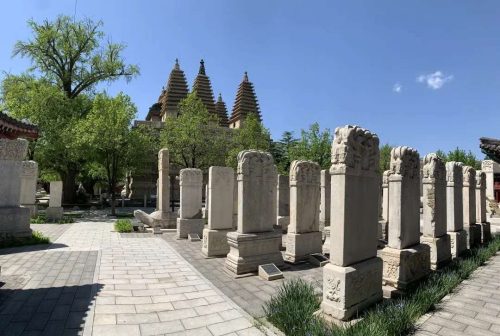
Before printing and newspapers, how did the Chinese make something “public”? With stone inscriptions. A road was built — a stele was raised to record it. A temple rose — a stele was set up to preserve the story. A merchant guild established itself in the capital — a stele served as proof. Stone inscriptions were the public bulletin boards, court rulings, and press releases of their day.
You’ll see a towering stele 6.44 meters high — the Guangningmen New Stone Road Stele, commissioned by the Yongzheng Emperor — the 18th-century equivalent of a major public-works completion announcement. You’ll also find 53 guildhall steles, the “proof of residence” for merchant associations from every corner of the empire.
You’ll also encounter a particularly striking stone: the Wei Zhongxian Living-Shrine Land Stele. During the Tianqi reign of Ming-dynasty, the powerful eunuch Wei Zhongxian petitioned to build a shrine for himself while still alive and to claim land for its upkeep. The emperor’s “Imperial Edict” approving the request was carved on the front of the stele. A man still living had already carved his own monument and built his own shrine. Later, when the Chongzhen Emperor took the throne, Wei fell from power and his shrines were torn down — only this stone remained. Stone doesn’t cover up for anyone — it takes in the scandals along with everything else.
Stop 3: Epitaphs and Tomb Carvings — Autobiographies Buried Underground
An epitaph is a self-introduction written for strangers yet to come. Western tombstones often carry little more than a name. Chinese epitaphs read like files: birthplace, family lineage, official posts, moral character, marriages, descendants. Why? Because whoever wrote them believed that one day, someone they had never met would reopen this tomb and reread this life.
You’ll read a Tang-dynasty epitaph from 729 — its subject a low-ranking military officer barely mentioned in the official histories, his full career preserved for 1,300 years. You’ll see the epitaph of the wife of the famous poet Nalan Xingde — a private grief solemnly entered into the public record. And you’ll encounter the tomb of a Ming-dynasty palace eunuch: a man with no heirs, not buried in the family plot — how did he arrange his own afterlife? It wasn’t rediscovered until 2003, during a construction project.
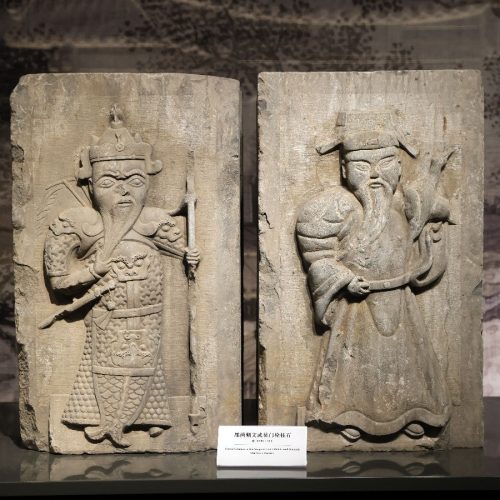
In the outdoor sculpture area, two Yuan-dynasty stone guardian figures over three meters tall stand side by side — a civil official holding his court tablet, a military official with his hand on his sword, extending the ceremonies of the living world into death. Not far away stands a spirit-path stone pillar dated to 105 AD — the earliest precisely dated stone inscription surviving in Beijing — raised for a minor Eastern Han clerk whose name never made it into the histories. His name has been standing in stone for nearly two thousand years.
Stop 4: The Jesuit Tombstones — Epitaphs from Two Worlds
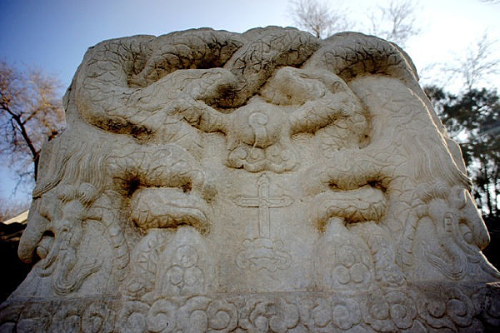
Walk past the epitaph section and the style suddenly shifts: a row of tombstones, Chinese in form, but inscribed in two scripts — Chinese, and a winding Latin alphabet.
These belong to more than twenty Jesuit missionaries who served in China during the Ming and Qing dynasties. Among them are Fathers João da Costa (Jiang Youren), Jean-Baptiste Régis (Lei Xiaosi), and Joachim Bouvet (Bai Jin) — the designers of the Western-style fountains at the Old Summer Palace, the chief surveyors of the Kangxi Atlas, the “King’s Mathematicians” sent by Louis XIV. They were not passing travelers; they were men who worked for the emperor, and so they were remembered in the Chinese manner.
Standing before these stones, you witness a kind of “reconciliation” carved in rock: at the top center of each stele is a cross, but flanking it are swirling Chinese-style clouds. One face is carved in Chinese, the other in Latin. The Chinese text speaks to the court and to posterity; the Latin text speaks to the Church and to God. This is how the Chinese honored foreigners with a monument — with respect, yet without erasing difference, entrusting their rest to a single shared stone.
Stop 5: Buddhist Statues and Prayer Pillars — Prayers Carved for the Next Life
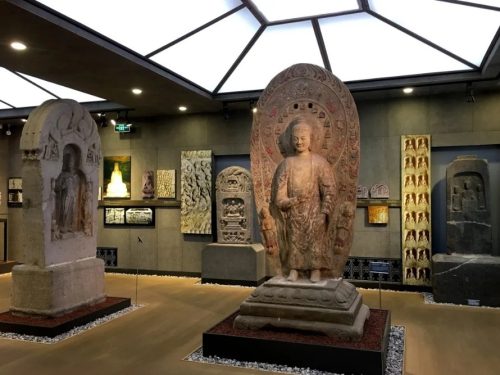
Epitaphs answer the question “how to be remembered.” But the Chinese faced another, deeper anxiety about death: what comes after?
The stone Buddhas, bodhisattvas, and prayer pillars in this section mostly came from temples around Beijing that were demolished. Their dates range from the Five Dynasties period through the Ming and Qing — the lean figures of the Northern Wei, the full forms of the Tang, the rounded, approachable faces of the Song and Yuan. The face of the Buddha was never fixed; it gradually grew into whatever the Chinese considered “solemn.” Beside the statues, you’ll often find an inscription recording who paid for the image, for whom it was made, and what prayer was offered. The wishes are mostly simple: for a departed mother, for seven generations of ancestors, for the safety of the whole family. Beneath a solemn Buddha sits a very human concern. Lean in and read one of these wishes — what someone prayed for a thousand years ago may not be so different from what you wish for today.
Prayer pillars (known as jingchuang) carry this impulse to its extreme: their eight-sided shafts are carved all over with Buddhist sutras. The scriptures say that the shadow of the pillar passing over your body, or even the dust that falls from it, can wash away sins. So carving a sutra was itself an act of merit — as long as the sutra stood, the blessing remained. Prayer pillars from the Tang, Liao, and Jin dynasties were thus set up in front of temples, at crossroads, and beside graves.
Epitaphs ensure the dead are remembered; statues and prayer pillars ensure the dead are received. Here, stone is not just an archive — it is a prayer.
Stop 6: Calligraphy Stones and Rubbings — The Art of Reproduction
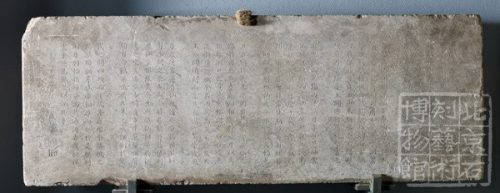
Before printing, how were famous calligraphic works “published” in multiple copies? The answer: carve them into stone. Masterpieces were cut into stone, rubbings were distributed across the empire, and students had models to copy from. Stone was the most reliable printing press of its age. Before the carved stones of the Yijinzhai and Jinghetang calligraphy collections(both carved in Qing-dynasty), you’ll see how brushstrokes long lost on paper were “frozen” into stone and preserved to this day.
Calligraphy stones preserve the name of the calligrapher, but the carvers usually remain anonymous. Fine writing lives forever thanks to the stone — yet the person who carved it has vanished into the stone itself. So at this stop, try to find a carver’s name on the inscriptions. Find one, and it becomes your own personal discovery.
Stone was also a carrier of knowledge: one Song-dynasty carving standardized acupuncture points as a kind of “national standard,” giving doctors a reliable reference for locating them.
Finally, you’ll try your hand at making an ink rubbing yourself. Paper is laid over the stone, pressed into the carved grooves, and ink is dabbed onto the raised surfaces — each rubbing is a kind of “data transfer.” Long before the Chinese invented printing, they used rubbings to reproduce knowledge on a large scale. The original stays put; the copies travel far. You can take home a rubbing you’ve made yourself.
Epilogue: Stone Remembers
In the end, we return to the foot of the Diamond Throne Pagoda and look at the museum itself — which is, in fact, the largest exhibit here.
Many of the stone carvings here came from temples and cemeteries that no longer exist. The stele of Longfu Temple still stands, but the temple is gone. Yuan-dynasty stone railings came from a vanished capital. The stone guardian figures were pulled from an active construction site. Behind every stone is a story of survival.
Outside the museum, the city keeps growing and time keeps wearing things away. Everything is being rewritten — but stone remembers. And now, so do you.
──────────────────────────────────────────────────
Your Guide: Gao Yu — A Cultural Scholar Who “Reads History Through Objects”
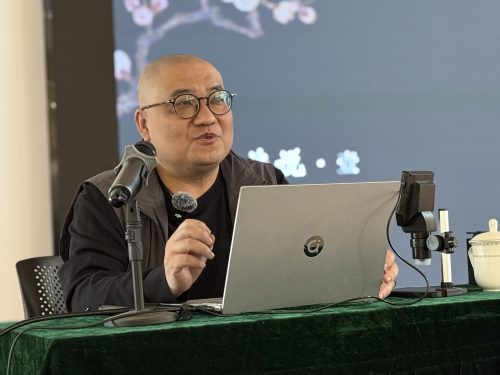
For this in-depth tour, we are honored to have cultural scholar and writer Gao Yu as our leader.
Mr. Gao Yu is no ordinary tour guide. He is a cultural scholar who specializes in “reading history through objects.” Enchanted by historical texts since childhood — for nearly thirty years now — he has developed a distinctive view of history: “culture as the essence, history as the surface,” holding that “changes in cultural genes steer the course of history.”
He has published two widely acclaimed works of cultural history: Pondering History: Seeing China in Jade, which retells the story of Chinese civilization through the thread of jade artifacts; and China in Porcelain: A Geocultural History, which uses porcelain as its entry point to explore China’s geopolitics and cultural change.
From jade, and from porcelain, what he has been reading all along is the political order, the aesthetic ideals, and the logic of power in ancient China. This time, he applies the same method to stone. In his view, stone inscriptions are the most honest carriers of history — paper rots, wood burns, spoken stories distort with retelling, but every character carved in stone is a solemn act of archiving. Spend three hours with him, and “steles” will no longer feel like cold rocks. Instead, you’ll come to see them as a Chinese system of memory you can clearly understand: who had the right to carve a stele, who was allowed to leave a name, what was worth preserving, and what was destined to be forgotten.
Mr. Gao Yu is also a certified inheritor of the intangible cultural heritage of Jiangsu Province. His dual identity as scholar and craftsman gives him a lived, practice-grounded understanding of the ancient Chinese tradition of “the vessel that carries the Way” — and it is this that grants him so singular a perspective when he reads this museum of stone carvings as a place where “stone carries the Way.”
──────────────────────────────────────────────────
Tour Information
| Item | Details |
| Duration | 3 Hours |
| Language | Bilingual (Chinese & English) |
| Tour Leader | Gao Yu (Cultural Scholar / Historical Writer) |
| Core Theme | “Stone Remembers”: How China Writes Memory in Stone |
| Target Audience | Foreign visitors interested in the deep logic of Chinese civilization; expatriates residing in China |
| Meeting Point | Main Gate of the Beijing Stone Carving Art Museum (Wuta Temple, Haidian District, near Zoo Metro Station) |
Booking & Inquiry
- Price: USD 120 per person
- Group Size: 4–12 persons per group (a boutique small group ensuring quality in-depth exchange)
- How to Book: Please send an email to michael_xgw@hotmail.com or add us on WhatsApp at 93museum
- Custom Sessions Available: Suitable for diplomatic missions, foreign enterprises, international schools, and other groups seeking tailored experiences
──────────────────────────────────────────────────
“At the Beijing Stone Carving Art Museum, you will understand: paper rots, wood burns, people forget — but stone remembers.”
──────────────────────────────────────────────────